US Government Releases Report on Pilot Studies of Cell Phone Radiation and DNA Damage
Safety is not assured, and questions remain unanswered.
Reposting courtesy of Dr. Joel Moskowitz, ICBE-EMF Commissioner and Director of the Center for Family and Community Health in the School of Public Health at the University of California, Berkeley.
From Dr. Moskowitz’ website Electromagnetic Radiation Safety, August 13, 2025
The DTT developed a small-scale radio frequency radiation (RFR) exposure system with a signal generator capable of generating a broader array of RF signals than the 2G/3G signals employed in the NTP studies. This system was developed to allow for efficient testing of later generations of cell phone technology (e.g., 4G and 5G).
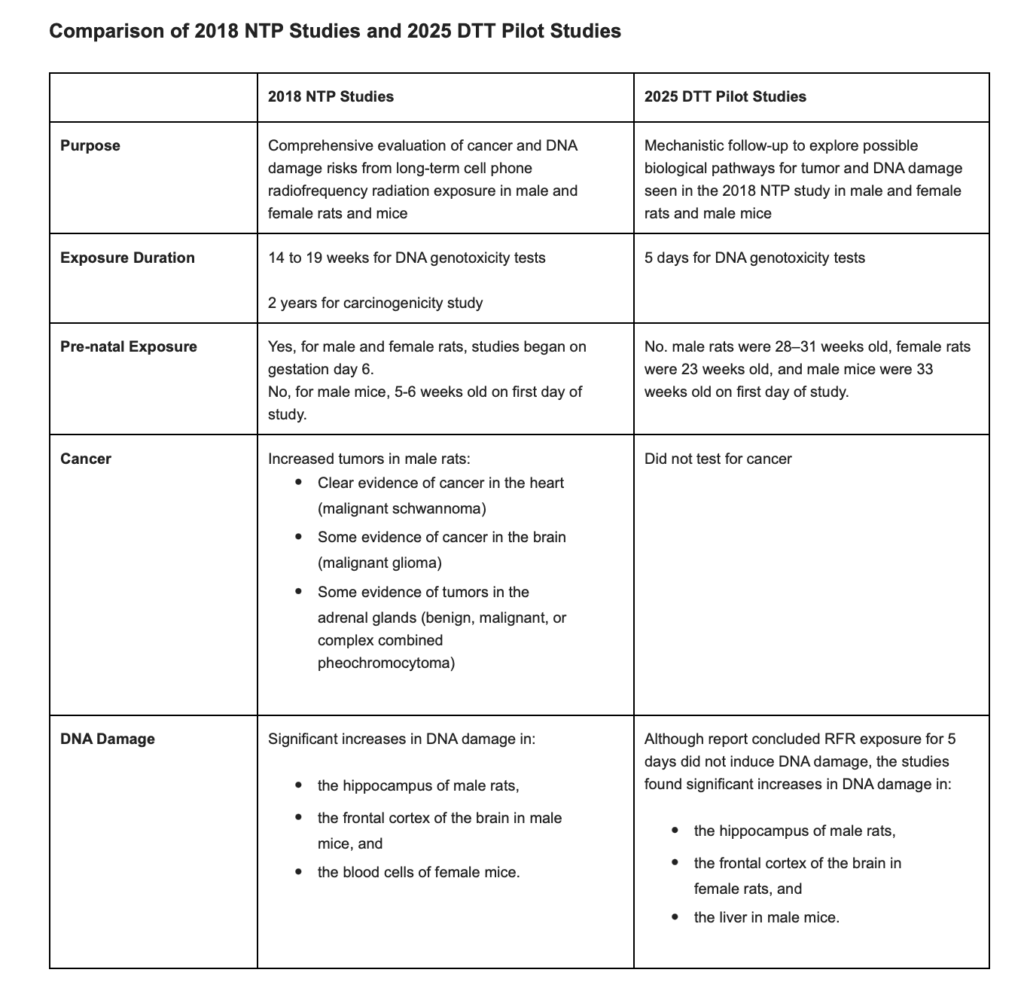
To help understand the NTP studies, the DTT conducted 2G/3G pilot studies that were limited to 5 days of exposure and used smaller sample sizes compared to the original NTP studies. Nevertheless, these peer-reviewed studies found statistically-significant (p < .05) (in addition to marginally-significant, p < .10) trend effects of cell phone radiation on DNA damage (Wyde et al., 2025):
“Despite a number of difficulties (i.e., engineering requirements, system modifications, measurement of body temperature during exposure), this small-scale RFR exposure system presents a prototype for investigative toxicological studies by researchers interested in conducting experimental RFR studies in rodent models. High-quality studies to understand the effects of RFR exposure on biological responses are needed given the widespread human exposure to RFR associated with cell phone use.”
“Also, NIEHS researchers found that exposure to RFR did not induce DNA damage, after five days of continuous exposure, up to 9 watts/kg in rats and 15 watts/kg in mice.”
And contrary to the report’s conclusions, the NIEHS stated:
“The research using this small-scale RFR exposure system was technically challenging and more resource intensive than expected… no further work with this RFR exposure system will be conducted and NIEHS has no further plans to conduct additional RFR exposure studies at this time.”
Based on the NTP studies, the NIEHS published a peer-reviewed paper which concluded that exposure to radio frequency radiation (RFR) is associated with an increase in DNA damage (Smith-Roe et al., 2020). The NTP found significant increases in DNA damage in the frontal cortex of male mice (both modulations–GSM and CDMA), leukocytes of female mice (CDMA only), and hippocampus of male rats (CDMA only) from 14-19 weeks of exposure to cell phone radiation. Increases in DNA damage judged to be equivocal were observed in several other tissues of rats and mice.