
Engineering Solutions To Mitigate Cell Phone Radiation Exposure
There are numerous hardware and software changes that can reduce exposure to cell phone radio-frequency electromagnetic radiation. Research links cell phone and wireless to numerous health effects from cancer and DNA damage to impacts on the reproductive, endocrine, immune and neurological system.
The ICBE-EMF published the peer reviewed paper “Cell Phone Radiation Exposure Limits and Engineering Solutions” in the International Journal of Environmental Research and Public Health on April 4, 2023 detailing several engineering solutions for cell phone radiation. While government limits for involuntary environmental ambient RF exposures (such as from cell towers and 5G ) need to be significantly strengthened, there are numerous measures that can be taken in the meantime. These six fixes can go a long way toward reducing cell phone radiation exposure from a phone.
Six Engineering Fixes
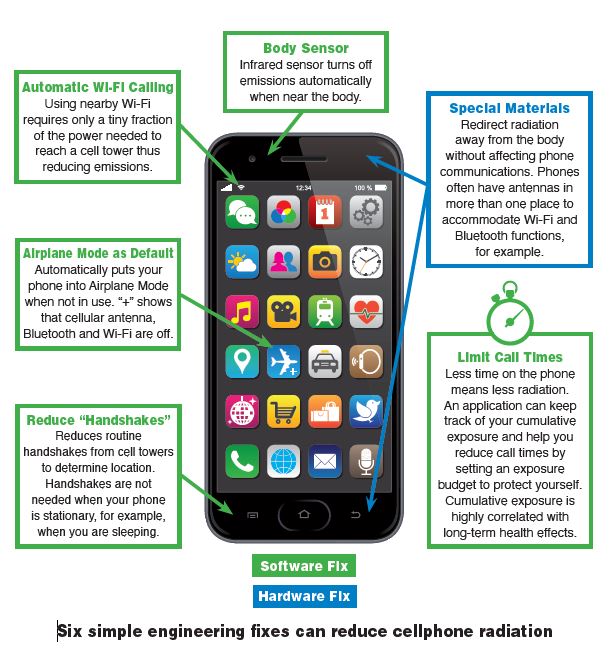
1) Use existing body sensors in Android and iPhone devices to detect when the phone is near the body and automatically turn off emissions.
Explanation: Body sensors already installed in cellphones are used to disable “soft” buttons on the screen to avoid inadvertent activation when holding the phone against the skin. These sensors could be modified to send instructions to turn off phone emissions as well. With only a small change in behavior—holding the phone slightly away from the head, using the speakerphone, or using a headset—the user would dramatically reduce cellphone radiation exposure.
Cellphone radiation “blocking” has already been implemented for several other purposes.
2) Use existing technology—already patented by many cellphone manufacturers—to reduce exposure from 2 to 100 times.
Explanation: When certain materials are put under cellphone antennas, they reduce radiation exposure through a process that causes interference. Incorporated properly, these materials would leave cellphone communications unaffected and tend to use battery power more judiciously.
3) Program cell phone software to choose Wi-Fi for calling whenever it is available.
Explanation: Calls using cell towers generally require the phone to run at between 0.6 watts and 3.0 watts in transmitter power. Wi-Fi calls typically require below 0.1 watts. Switching to Wi-Fi whenever available also extends battery life.
4) Reduce “handshake” transmissions by eliminating them when the user and therefore the user’s phone are not moving.
Explanation: Handshake transmissions allow cell towers to track cellphone locations. This keeps the phone in contact with the nearest available cell tower as the user moves by car, by foot or by other means. There is no need for continuous handshakes if the phone is stationary, for example, on a bedside table for the night. The phone’s built-in GPS and accelerometer make reducing handshakes possible by tracking changes in location and motion.
5) Make airplane mode the default setting.
Explanation: Airplane mode prevents a cellphone from transmitting. When the phone is not in use, it could be placed in airplane mode automatically until the user needs to use it again. Users can, of course, easily change this setting for times when their phones must be connected to the cellular network to receive anticipated calls, texts and email. Airplane mode also conserves power.
6) An application could be used to limit the duration of cellphone calls.
Explanation: Software could monitor cumulative radiation exposure in real-time and adjust the duration of phone calls to limit exposure. The necessary functions are already available in existing applications except for a function that will end calls (with appropriate warning) when pre-set exposure limits are reached.
Regulatory Blind Spots
Current safety standards for cell phone radiation do not protect public health (i.e ICNIRP, IEEE and FCC limits). Below is a list of seven blind spots that reflect a deep misunderstanding of toxicology, biology, and medicine.
1) Inappropriate focus on a single variable, heat, while ignoring non-thermal effects.
Explanation: There is no known threshold for the biological effects of radiofrequency radiation (RFR) in humans. In other words, all cellphone and cell tower RFR will cause biological effects in human cells regardless of the level of exposure. The current regulation only considers heating from RFR as a danger and so disregards the effects caused by much lower exposure levels.
2) Reliance on acute exposure experiments performed over remarkably short times.
Explanation: Current standards are based on exposures lasting 40 to 60 minutes. Humans are now facing exposure to cellphone and cell tower radiation 24/7. The testing that current standards rely on has little relation to the chronic exposures to which humans are now subjected virtually continuously.
3) The safety recommendations overlooked important time and amplitude characteristics of the signals.
Explanation: The current standards allow for “averaging” of RFR intensity over periods of 6 minutes for occupational settings and 30 minutes for the general public. This ignores the vast and extremely rapid variations of the digital signals produced by today’s devices, variations that set off biological effects at the cell level. Digital data “bursts” happen many times a second, going from very low energy to very high energy. These peaks are especially important in causing biological effects.
To analogize, imagine someone punching you relentlessly for six minutes. In order to throw a punch, that person has to withdraw his/her fist each time and then accelerate it toward you again. But if you take the average distance from the attacker’s hand to your face for those six minutes, the attacker can claim that on average his/her fist was only halfway between the two of you and that therefore he/she on average never even touched you. This is analogous to the averaging allowed under the standards.
4) Carcinogenicity, electromagnetic sensitivity, and other diseases and health conditions were ignored.
Explanation: FCC, IEEE and ICNIRP limits only consider effects from heating as “established” so it is all they were designed to protect for. Research has documented health impacts at levels well below these limits. Epidemiological studies have reported significant associations between exposure to RFR and increased risks of glioma [brain tumors], acoustic neuroma [inner ear tumor], and thyroid cancer, among others. Yet cancer is not an effects that FCC, ICNIRP and FCC limits were designed to address. Despite exploration and documentation of electromagnetic sensitivity, industry and governments have not reacted to curb emissions.
5) Specific Absorption Rate (SAR) measurements for cellphones use an arbitrary gap between the phone and the head.
Explanation: “Modeling SAR values with precision at small distances from the head (in the near field) and in proximity to complex layers of biological tissues is difficult and carries an uncertainty of at least 25%. Most notably, SAR decreases by at least 12.5%/mm for very short distances as a cellphone is moved away.”
6) SAR doses were averaged at volumetric or mass scales irrelevant to health.
Explanation: The current models used to determine SAR for humans assume that “tissue is uniform in structure and in its sensitivity to RFR, while in fact it is heterogeneous and anisotropic [that is, having different properties in different directions] at the cellular, organelle, molecular, and particle levels.” A safety standard resting on this model cannot be deemed reliable.
7) Cell Phone SAR simulations did not represent realistic situations.
Explanation: Current models estimate exposure based on the phone and head. A realistic model would include the hand holding the phone. When this is done, “a substantial proportion of the radiated power dissipates into the body, with a modest remainder actually available for wireless communication.”
Read more about the need to strengthen safety limits.